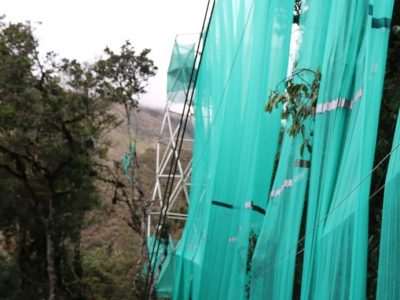
Wayqecha, meaning "brother" in the local native language of Quechua, is located in the district of Kosñipata, Paucartambo Province, Cusco Region, Peru. It lies adjacent to Manu National Park and within its buffer zone.
Number of species recorded: Orchids (239), Amphibians (15), Reptiles (4), Birds (257), Mammals (35)
Recognized in 2016 by Peru’s Ministry of the Environment as a Private Conservation Area - ACP (RM Nº 357-2016) in perpetuity.
Discover Wayqecha
Discover the biodiversity it protects
Monitoreando plantas consumidas por el oso andino.
Foto: Maxime Aliaga.
Laboratorio de la Estación Biológica Wayqecha.
Photo: Walter Wust
Bosque Nuboso de la Estación Biológica Wayqecha.
Photo: Maxime Aliaga
Investigadores del Team Ukuku instalando cámaras trampa a 3700 msnm.
Foto: Ruthmery Pillco
Orquídea Epidendrum secundum.
Photo: Walter Wust
Colibrí Coeligena torquata.
Foto: Maxime Aliaga.
Wayqecha is the only research station in Peru located near the transition between cloud forest and puna grasslands, providing unique access to both ecosystems.
Our facilities are surrounded by cloud forests, dwarf forests, montane scrublands, and puna grasslands. Although the terrain is steep, it is accessible through an extensive network of trails.
These ecosystems provide ideal conditions for many species of orchids, bromeliads, mosses, and lichens. In addition, there is a great diversity of hummingbirds and moths.
Among the large mammals found near the station are the Andean bear (Tremartocs ornatus), puma (Puma concolor), Andean fox (Lycalopex culpaeus), and the white-tailed deer (Odocoileus virginianus). To date, approximately 250 bird species have been recorded, including the Andean toucan (Andigena hypoglauca) and 26 species of hummingbirds. The area is also home to 15 amphibians species, mainly represented by the genus Telmatobius and Gastroteca.
Science and conservation
PROTECTING THE AMAZON THROUGH SCIENCE
At Wayqecha Biological Station, we offer a wide range of field courses each year in collaboration with partner universities and academic programs. These courses provide students with an invaluable opportunity to immerse themselves into the beauty and diversity of tropical cloud forests while gaining theoretical and practical knowledge from experts in the field.
Our field courses are designed to cover a wide range of disciplines such as conservation biology, tropical ecology, biodiversity, and climate change. Students participate in field research, conduct sampling, data analysis, and engage in an immersive learning environment amidst the lush nature of Wayqecha.
We also encourage collaboration between students and scientists from around the world. Our diverse and passionate academic community fosters the exchange of ideas and the generation of knowledge essential for conservation.
For academic inquiries, contact: Ciencia@conservacionamazonica.org
Learn about the ongoing projects:
Learn about the ongoing projects:
ANDEAN BEAR PROGRAM
The Andean bear (Tremarctos ornatus) is the only bear in South America and is endemic to the Tropical Andes. Discover how we use science and research to protect this iconic species.
Frogs of the species Phyllomedusa camba are nocturnal and camouflage themselves during the day thanks to their green coloration. We are working to protect these unique species.
Researchers analyzing plant tissue samples at the Wayqecha laboratory.
Photo: Ruthmery Pillco / ACCA
Visit us
If you are a naturalist, birdwatcher, or nature enthusiast, we invite you to discover our biological stations! Enjoy a unique experience at Wayqecha, Manu, and Los Amigos, where you can explore Andean-Amazonian biodiversity and observe birds in their natural habitat.
 English (UK)